This education SEO case study documents measured Google Search performance from an education and training project in Dubai. The available Google Search Console screenshot records 12.6K clicks and 421K impressions over six months.
The project operates in a search environment where users can look for specific courses, professional training, certifications, languages and career-focused programs. That creates a different SEO structure from a simple service website because individual programs can each carry their own search intent.
As with my other case studies, I separate what the screenshot proves from what it does not. It proves the recorded Google Search clicks and impressions for the selected period. It does not independently prove enrolment numbers, revenue, or that every click came from one isolated SEO change.
Education SEO Result at a Glance
- Industry: Education and professional training
- Market: Dubai, UAE
- Google Search clicks: 12.6K
- Google Search impressions: 421K
- Reporting period: Six months
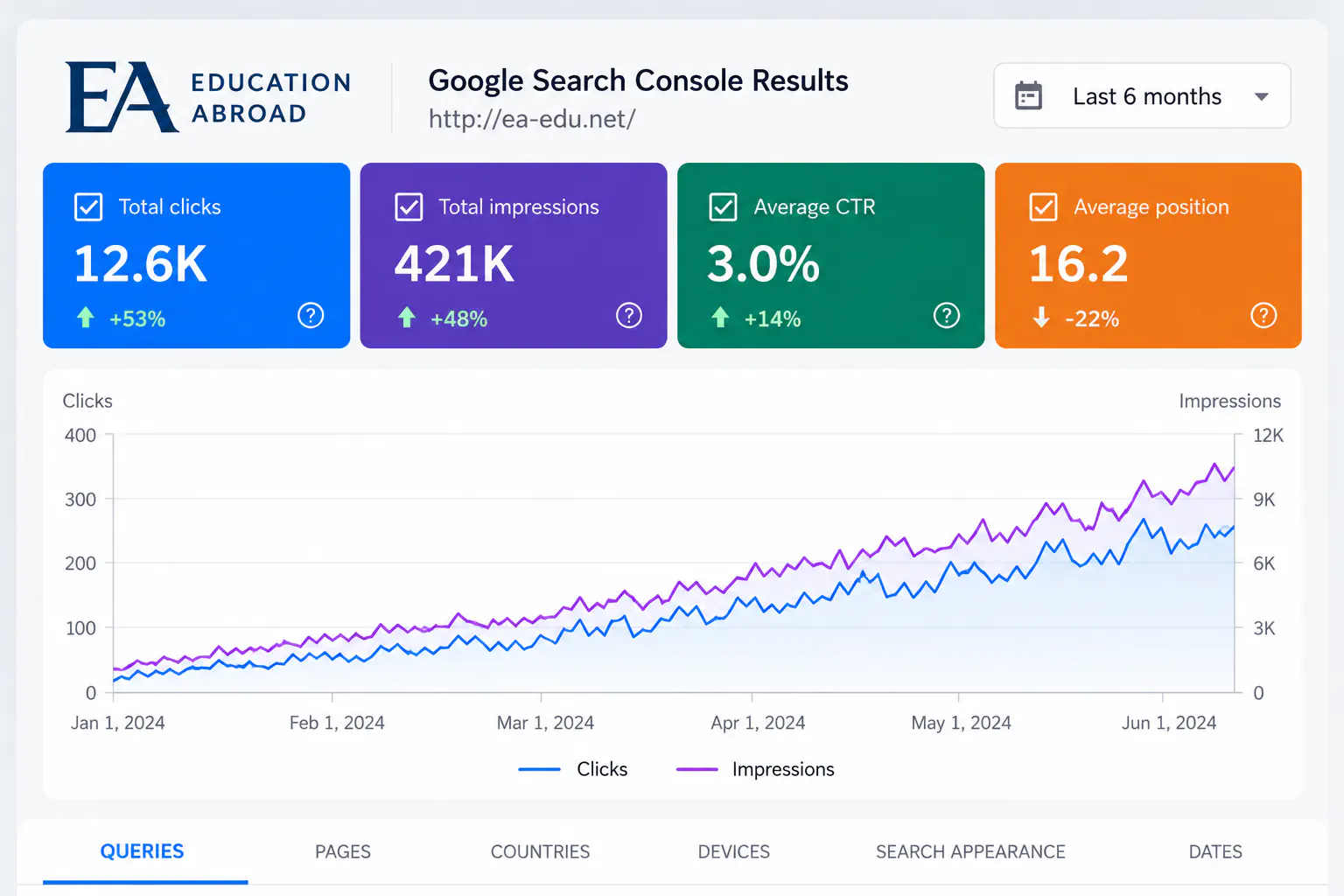
The screenshot above is the evidence for the search-performance figures used throughout this case study.
Why Education Websites Need Strong Information Architecture
Education websites often contain many different intents: a user may search for a broad training category, a specific course, a certification, a language program, an exam-preparation course or information about schedules and eligibility.
If every topic is pushed onto one page, search engines and users have a harder time understanding which page is the best answer for each query.
A more scalable structure can include:
- Core training category pages
- Individual program or course pages
- Accreditation and quality information
- Trainer or instructor information where relevant
- Frequently asked questions
- Supporting educational guides
- Clear registration and contact paths
The number of pages should follow real program offerings and search intent, not an artificial goal to publish as many URLs as possible.
What 421K Search Impressions Mean
Search Console impressions indicate appearances in Google Search results. The 421K figure shows broad visibility during the selected six-month period.
Visibility is useful, but it is not the final objective. The screenshot also records 12.6K clicks, giving a direct traffic signal from Google Search.
For an education business, the next measurement layer should ideally connect those visits to actions such as course enquiries, calls, registrations, consultation requests or completed enrolments.
Course Pages Should Match Specific Search Intent
A user searching for IELTS preparation has different intent from someone searching for cybersecurity training, leadership development or digital marketing courses. Dedicated course pages allow the website to match those needs more precisely.
Useful course-page information can include:
- Program name and learning objective
- Who the course is designed for
- Curriculum or learning outcomes
- Delivery method
- Schedule or duration
- Certification details where accurate
- Location
- Registration or enquiry CTA
The page should help a prospective student make a decision, not simply repeat the same training keywords.
Local SEO Is Relevant for Dubai Training Providers
When courses are delivered in person, location becomes part of search intent. Users may search by Dubai, neighbourhood, training centre type or nearby options.
Local SEO can therefore support the main organic strategy through accurate business information, Google Business Profile, reviews, location relevance and strong landing pages where a real physical service is offered.
See my Local SEO Dubai guide for the wider local-search framework.
Content Can Support Course Discovery
Educational content works best when it helps users understand their options. Useful supporting topics can explain course differences, career paths, certification questions, entry requirements or how to choose between training programs.
Those guides should link to the relevant program pages naturally. This creates a topic cluster instead of a blog that is disconnected from the commercial side of the website.
The same architecture principle supports my own SEO services in Dubai: supporting content should strengthen the pages that actually represent services and business intent.
Search Console Helps Prioritize Education Content
For a training website with many courses, Search Console is especially useful for identifying:
- Programs already earning impressions
- Queries where a relevant course page exists but ranks weakly
- High-impression questions that deserve supporting content
- Pages with visibility but low click-through rate
- Search demand around course categories or certifications
- Potential cannibalization between similar program pages
This makes content planning evidence-led rather than based only on brainstorming.
Technical SEO Still Matters
Course websites can become complex as programs, languages, registration pages and content expand. Technical SEO should keep that growth manageable.
I review:
- Indexable versus non-indexable pages
- Canonical URLs
- Internal linking
- Duplicate program content
- Mobile performance
- Structured data where appropriate
- XML sitemaps
- Redirects when course URLs change
My Technical SEO Dubai checklist covers these areas in more detail.
What This Case Study Proves — and What It Does Not
Proven by the Search Console screenshot:
- 12.6K Google Search clicks over the selected six-month period
- 421K Google Search impressions over that period
Not claimed without additional evidence:
- A specific number of course enrolments
- A specific revenue figure
- A specific percentage growth versus an earlier period
- That every click came from one single SEO initiative
- A guarantee that another education website will reproduce the same numbers
Lessons for Education and Training Websites
- Give each important course a clear search purpose. Avoid forcing unrelated programs onto one generic page.
- Use supporting content to answer real student questions. Then connect it to relevant course pages.
- Measure search demand by program. Search Console can reveal which topics already have visibility.
- Protect the site architecture as the course catalogue grows. Internal links, canonicals and redirects matter.
- Connect organic traffic to enrolment actions. Clicks are a strong SEO metric, but business measurement should continue beyond the visit.
Frequently Asked Questions
Does 421K impressions mean 421K students visited the site?
No. Impressions are appearances in Google Search results. The screenshot separately records 12.6K clicks.
Should every training course have its own SEO page?
Only when the course is a genuine offering and the page can provide useful, distinct information. Thin or duplicated course pages can create more problems than value.
Does this case study guarantee the same result for another academy?
No. Search demand, competition, course portfolio, website history and implementation differ across projects.
Final Takeaway
The available Search Console data records 12.6K Google Search clicks and 421K impressions over six months for this education and training project.
For additional evidence-based SEO work, see my Dubai SEO case study, fashion SEO case study, SEO services in Dubai and the main digital marketing Dubai page.

Ali Alkhatib
Informatics Engineer and digital professional working across web development, SEO, Flutter applications and digital growth in Dubai, UAE.